Friday, 5 May 2017

QUESTION- IN WHAT WAYS DOES YOUR MEDIA PRODUCT USE, DEVELOP OR CHALLENGE FORMS AND CONVENTIONS OF REAL LIFE MEDIA PRODUCTS?


Fowler’s 1989 theory that ‘An individual text within a genre rarely if ever has all of the characteristic features of the genre’ is a theory by which our text fully supports. Our teaser conforms to the conventions of the social realism genre in some instances: the use of wider social issues explored via emotional and dramatic individual stories such as the issue of child prostitution found within 'London to Brighton' or heroine addiction portrayed in 'Trainspotting' this issue in ours being the social issue of sexual assault. This issue is the primary focus also of the music video 'Til it Happens To You' by Lady Gaga which we use as a comparison at the end of the video above. Characters being normally young adults between the age of 13 and 25, whom are cast by non professional actors that add to the realistic look such as Sean in 'This is England', our actress is unknown whilst also being aged 18 thus conforms to this convention also. Tracking shots of the main protagonist especially with the use of a handheld camera, used throughout 'Fishtank' with the shots of Mia, that is illustrated through our text with the tracking shots of our protagonist on public transport. Lastly, the use of location scouting evident within the Yorkshire country and industry of 'The Selfish Giant' we replicate with the use of the Oxleas woodland to use as the location where the sexual assault occurred in contrast to her domesticated bedroom this is illustrated within our shot used above of our graphic match where the protagonist is found in both locations.

Furthermore we develop the use of wide angle shots instead focussing primarily on extreme close ups, this proves better for characterisation as these shots help evoke sympathy from the viewer, this is highlighted in the video above through the extreme close ups of the subliminal rape: this technique despite not being a convention of the genre, has been used widely in real media texts of our genre namely 'London to Brighton' and 'Fishtank' and 'Til It Happens To You', as this is technique is proved more effective with female characters. In development of our tracking shots also, there are shots of our protagonist on public transport through a window shot that is mirrored in real media texts such as 'Fishtank'; 'Bullet Boy'; 'London to Brighton'.

However, as Fowler highlighted it would ‘rarely if ever [have] all of the characteristic features’, therefore we have subverted some of the known conventions such as the use of semi- improvised scripts to achieve life-like conversations; instead of using dialogue as a technique to illustrate narrative we instead focussed on symbolism as a key means to portray the protagonist’s emotions and feelings, whilst also being an experimental means of editing that moves away from realism. We captured extreme close ups of pomegranates being sliced to represent fertility and reproduction, due to its seeds. Coupled with another symbol of fertility being an egg, we utilised a close up high angle stop motion, its shell intended to highlight the fragile vulnerability of the female protagonist’s psyche, and produce tension from the outset. The post-production blue tint to the egg was in keeping with our intended cobalt colour palette, a symbol of her psychologically drowning. The finality of the piece where the white liquid reveals the title sequence was achieved by gradually pouring milk within a box so that it separated in the water due to their different densities. This extreme close up eye level shot proved highly effective since the intended symbolism of the milk representing purity and fertility. Symbols however are also used in other real media texts such as the horses within 'Fishtank' and 'Selfish Giant' that represents the strived freedom of both Mia's and Swifty; the heroin in 'Trainspotting' to demonstrate their isolation and the gun in 'Bulletboy' to highlight corrupted childhood. 

QUESTION- HOW EFFECTIVE WAS THE COMBINATION OF YOUR MAIN PRODUCTS AND ANCILLARY TEXTS

Insert link to website
Insert poster
Insert screenshots to website

Our main product was a 70 second teaser trailer that introduced our full length feature film piece. Combined with this, we created an advertisement poster and a website that provides all the needed information, with links to a Facebook account where our teaser trailer was posted in order to gain feedback.

Our main product is effective due to the gritty, realistic tone that we attributed to it. The opening sequence of the piece is a combination of shots from the sexual assault scene cut against the POV shots of the aftermath in the woods. This set of shots were particularly effective as they made our trailer hard to watch, with many audience members feeling discomfort however

Demonstration of how the three texts achieved their effect together (made on Piktochart).
https://magic.piktochart.com/output/21801118-grace-the-movie

Todorov's theory of equilibrium explains that a piece follows the generic narrative arc of its genre and that there can be a new equilibrium reached concerning certain characters that cannot be returned from. Our trailer starts with scenes from a rape and our protagonist follows the narrative arc until the climax under the assumption that her attack was her fault. It is not till the climax of the piece (seen through a close up shot of Grace breaking the fourth wall at the end of the teaser) that a new equilibrium is reached when she understands that the attack is not her fault and she did not cause it. Our poster also helps support this theory as our tagline is split into two statements, one from before the climax and one after wherein Grace emerges from her attack with her new understanding and the focus is then on her recovery. Adding to this our website also contains our tag line and has reviews, one of the longer more detailed reviews talks about "the victims of sexual assault". The equilibrium reached in this quote focuses in on the victims inability to forget what hasn't happened and emphasises that they are victims, not at fault.

The combination of our texts is effective in matching the conventions of the social realism genre


QUESTION- HOW DID YOU USE MEDIA TECHNOLOGIES IN THE CONSTRUCTION AND RESEARCH, PLANNING AND EVALUATION STAGES?


Final Cut Pro would be the element of technology most imperative to the construction of our teaser trailer, as not only did it comprise our footage together to create our teaser trailer but was fundamental in all elements of our post production. Examples include the post production of our sound which included the layering of sounds: the non diegetic soundtrack, underlying wind recording and record player needle that is layered at the start and finish. In the video above it illustrates how we composed a compound clip of our music, since the conventions of a teaser is to be between 60- 90 seconds, our 3 minute soundtrack would be too long for it all to be included, therefore, to make it appear like a non- diegetic record player skipping we bladed the last 0.5 seconds of soundtrack in the middle of the 'ooo' sound, and repeated it 3 times layering them on top of one another: the repetition imitating a skipping record. Furthermore, to instil our colour scheme within our teaser trailer it allowed us to add tints to elements of our teaser trailer examples being the stop  motion of our egg which had a cobalt blue tint overlaid to fit into our teaser, in order to create the stop motion itself we had to create a compound clip. Within this compound clip, we had two clips of the egg in the same position (one with a crack the other without), utilising a straight cut edit between the two, it made the egg appear as if it broke itself which was our intended effect. Moreover, we to make the protagonist appear disorientated, within post- production using Final Cut Pro, we duplicated the footage four times, then layered them on top of another having each start consecutively after the other; reducing the opacity of each clip, their transparency ensured you could see all four clips at one. This created through post- production the effect of her feeling faint from understanding what has happened, as each clip lacked clarity and each moment appeared to extend slower. Not only this, but we had to incorporate text into our piece wit the use of reviews, titles and cast, therefore to have our piece correspond to the ancillary texts we used the same font (refer to separate blog post on ancillary texts). What was important however was the placement of text, being in shots to reduce wasted space, or to fade in with corresponding footages (such as when the milk is poured into the water, the 'Grace title fades in with it.)


Aurasma was incorporated additionally to give our promotional poster an edge, whilst also combining our ancillary text with the teaser itself. In the video above is the process of creating the Aura and also the final effect, which as a promotional package is more inviting and targeted towards our target audience aged from 18-35. We had to upload a trigger image which in our case was our film poster, this is the image that the audience hover over with their phone, then we had to upload an overlay that from the above footage is obviously our teaser trailer.

In order to produce our website we had to construct a website which was produced using Wix.com. Researching into possible templates associated with creative careers (art portfolios etc) until we found our appropriate template. From this we manipulated and changed the template incorporating fades, text and moving backgrounds. Not only this, we created additional tabs for extra information such as: statistics, crew etc. One of the strengths of Wix is that they allow you to time when certain aspects of the website appear on screen, therefore, the screen is just an emotive image of our protagonist, until 3 seconds later our teaser trailer, tagline, title and reviews all appear at once within a fade. Wix tools, also, allowed us to create a slideshow of reviews so they appeared consecutively after one another- this was because we did not want all our reviews on the website at once since we felt it would make the website appear cluttered and distract from the emotive footage of our protagonist.

Utilising Adobe Photoshop we created our promotional poster focussing especially on layering so that we incorporated the protagonist, reviews, tagline, and location. The tools used especially were elements such as the eraser tool, but also tints to incorporate our colour scheme as we did with the egg. Layers are paramount to the construction of our poster, as we had to layer a number of aspects: images of the woodland; the outline of the males face; the photograph of our protagonist; images of the feathered bedroom; the title; tagline; reviews; social media components and website.

Blogger was of equal importance to Final Cut Pro, being crucial to our research and planning of our product and ancillary texts. This was through deconstructions of teaser trailers, film posters and websites to be influenced by real media texts of our genre and also understand the conventions of our genre also that we were willing to conform to and subvert. Furthermore, through blogger we illustrated audience feedback from elements such as pitches, surveys and questionnaires to manipulate and change our text according to their feedback. Not only this but we could evaluate our construction stages throughout, finding strengths and weaknesses within each stage and changing our products accordingly. Research was also undertaken of similar media texts such as their narrative, plot, characterisation, music, colour schemes and cinematography.  Planning stages were posted and discussed such as our story boards, pitches and narrative arc to produce our ideas within a more concrete format.

QUESTION - WHAT HAVE YOU LEARNED FROM YOUR AUDIENCE FEEDBACK


Deconstruction of London to Brighton teaser trailer

The London to Brighton teaser trailer starts off with a slow, melodic non diegetic soundtrack that mirrors against the diegesis of the three main characters of the film discussing the details of a young girls life and how she has come to live on the streets. This is immediately identifiable as a social realism piece focused on homelessness and prostitution, Joanne is an 11 year old girl who has been hired to perform sexual acts with an older male. 
The trailer highlights the issues of child prostitution and as the piano track builds tension against the on screen diegetic discussions, it makes way for a much faster, techno beat non-diegesis that is coupled with a faster pace of editing as we see shots of Kelly and Joanne on the run from the police and the Pimps. This trailer is able to make the audience sympathise with the young girl and the female prostitute whilst being repelled by the acts of the male leads in the piece. The fast paced non diegetic track alongside the sounds of the girls screaming/crying builds a very high rate of suspense and makes the piece gritty and real. By naming famous places i.e.: Brighton the audience are encouraged to realise that the violence and criminal acts happen all around them and are not an isolated incident as it covers England from London to Brighton. 
The teaser trailer ends with the off screen diegetic sound of a shotgun blast against a black screen with white title logo.

Deconstruction of transpotting teaser trailer

The teaser trailer for Trainspotting features a childish group of boys running down a railway track, revealing that they have tied up one of their friends to the tracks, shortly before the train is due to arrive, "That is, if its not late!". Seen in the trailer, there is a close up shot sequence of the main character (Renton) tied to the tracks and offering advice to the audience (thus breaking the fourth wall), this advice is countered by the narrative of the film and offers a cheeky view on life. 
Renton is still laughing as he explains that the most important rule is, "don't let your mates tie you to the railway track!" Trainspotting revolves around how Renton's life is troubled by the social group he is a part of and by tying him to the railway tracks, they have condemned him to his death and allowed him to be run over by the train. This isn't something that would be seen as what a friend would do for you and therefore from the onset of the trailer we know that Renton is different from the others. This difference leads him to be tied up in this situation and then the inevitable happens as the off screen diegetic sound of a train approaching coupled with a POV shot of the train facing Renton makes up the climax of the trailer.
This climax finishes with a black screen with a scrolling title of 'Trainspotting' panning across the screen at high speed, synchronous to the sound of the train. This lets the audience know that Renton has been hit by the train and wasn't saved by his social group. Trainspotting is Danny Boyle's commentary on the lack of social mobility that Scottish working class youths felt in the 90's and this is particularly relevant as Renton can't escape this situation that his friends have got him into.

Inspiration- A girl like her

A girl like her takes on a completely different style of filming. By reflecting the styles of a POV camera piece it showcases the private and public lifestyles of two girls, providing insight into a girl who bullies someone who ends up committing suicide. This piece gave us inspiration as our narrative involves our actress attempting suicide and in our shooting script we planned to have a variety of POV shots of Grace coming out of the woods after she has been attacked.

The film makes a statement on how everyone around the girl who commits suicide has some part to play in her act and this helped us when we were planning what shots to include in our main product due to our commentary on how society fails victims of sexual assault.
A Girl Like Her also helped to influence our piece as the film focuses in around the mental health of teenage girls, this helped us with our piece as we were aiming to represent this age group as realistically as we possibly could. Some of our original shot ideas were taken in school and we had similar shots of bullying from other students as seen above.

GRACE A2 Media CourseworkWe were able to use this idea of POV filming to connect more with the audience in a disorientating sequence of clips that are cut against shots of the rape occurring. We decided that this would be particularly effective as watching A Girl Like Her puts you in the place of the suicide victim and therefore by having the same camera shots were were able to utilise this idea of bringing the audience in and get them to feel the same way.

Thursday, 4 May 2017

Deconstruction of trailer to fishtank

Andrea Arnold uses the trailer to Fishtank to present Mia as a misunderstood teen on a council estate, who suffers from a failed system which leads to her acting in a criminal/less than respectable manner through carefully chosen shots of an average 'council estate chav' against black screens with insights into the narrative of the piece. Mia finds comfort in an older man that her mother is seeing sexually and we begin to see a cyclical pattern between Mia and her mother.
Mia is clearly trapped within her social group and there is clear signs that she is giving her all to move up and have social mobility however the company she keeps doesn't encourage a positive movement and instead result in her drinking and being promiscuous at "only 15".

Arnold couples the clips from the film against a dramatic non-diegetic soundtrack that is parallel to the pace of the editing in order to build up to a climax that we see at the end of the trailer with Mia dancing. This offers some insight into the narrative of the piece as she clearly has the intention of becoming a dancer however the issues she faces holds her back from achieving her goals.

Reflection of our media product

Our media product allowed us to successfully portray the failed justice of a victim of sexual assault, there are clear themes of isolation and a troubled mental state, with symbolism indicating an attempted suicide.

I would say that upon reflection, we were able to adhere to the codes and conventions of our chosen genre in order to generate the correct tone that we wanted to. Our use of mise en scene allowed us to explore how we could represent the issue that sexual assault can happen to anyone at any time. By having a plain clothed actress with simplistic hair and make up designs we were able to show off an 'average' teenage girl who is attacked by our antagonist who we do not show explicitly however we used intelligent camera angles to still 'show' the attacker in shots.

Our opening scene to our trailer depicts the rape through a combination of straight cuts between close and extreme close ups of the attack and the POV walking through the forest of our actress after she has been attacked. Originally we had planned to have a male actor seen in these shots however there was a clear issue with how distressing these scenes came across and we believed that we could more accurately justify the emotion attached to this act by having the attacker be 'invisible', as there is no clear sign as to who could act in this way, and in our piece we tackle the issue of who is to blame for the issues faced by the victim.
GRACE A2 Media Coursework
By not having an actor seen we tackled the issue of how society reacts to victims of assault and we displayed the lack of input members of the general public offer up. The hypodermic needle theory suggests, for our piece, that we should encourage people to speak up about their negative views towards sexual assault however it is evident (seen through a high angle shot of our actress on public transport, isolated from society) that it is not only the attacker that is at fault, but everyone who fails to act in order to bring the attacker to justice.

A slow-paced remake of "You're the One that I Want", from the film Grease provided us with a non-diegetic soundtrack that dominated the sound for the trailer. Whilst there are other tones underneath this track, the vocals from the song dominate the trailer. We chose not to have any narration in our teaser trailer as the words from the song are perhaps more emotive as they are subverted by the actions of the antagonist and the attempt of the protagonist to reach out and escape the feeling of isolation. "The one I need", here could refer to how our actress is portraying a character who is desperately reaching out and trying not to be alone in her time of need, yet in every shot we see her there is no one nearby to help. Indeed, the only shot where members of the general public are seen, Grace is separated by a sheet of glass on the bus.

Our ancillary texts enabled us to further exaggerate the need for focus to be on the protagonist and helping the recovery of the character, and bringing light to the identity of the attacker in order to bring him to justice. Our film poster utilised the idea of shadow art in order to 'hide' the identity of the attacker, half covering Grace's face. This was done to signify how often the victims of sexual assault dont find justice as proving their case is either difficult or faced with difficulty. The other main villain in our piece is society as a whole not standing up for the victims of sexual assault and therefore not bringing the villain to justice.
Our tagline was particularly successful at demonstrating how we had presented the full narrative of our planned film as the climax of the piece is Grace realising that the attack was no fault of her own and the villains are the attacker and society's failure to help her.

When creating our website for our full length film, we looked towards other pieces in order to help us identify what made a successful website.
The centre piece of our website is a close up shot of Grace looking towards the audience, in a still image our protagonist breaks the fourth wall against reviews from film companies that cover social realism films and drama film that our similar to the genre of our own piece (social realism). Our title is enlarged, making a one word title more effective as we allow the audience to identify with the protagonist however there is still a clear sense of tension due to the audience understanding that society has failed to act in any of these cases and this makes the piece real. Again the tagline helps to provide insight into the full narrative of the piece.

Harlem Nights Deconstruction

Harlem Nights is a comedy take on the periodical drama and action genres. When beginning to consider what we would do for our A2 piece, we thought a lot about the current issues facing society. Harlem Nights focuses in on gang violence, police corruption and weaponry.
The trailer has a voice over with an almost comical tone to it, taking away from the serious violent tones of the shots being shown, the comparison of these two helps to achieve the seriousness needed in order to understand the danger that the lifestyle of these characters brings, whilst doing so in a funny and light hearted manner.

"The man to know, was Quick." This line tied in with the diegetic conversation we see two of the gangsters having creates a position of authority for the character named 'Quick', who we see is identified by a shot of Eddie Murphy as his name is mentioned. This helps the audience to be able to connect to who the characters are from the onset.

The subversion of character types by having a male lead 'Quick' who is knocked over by one of the burly female dancers takes away the traditional male view and makes his character appear as the 'new man', more comical and easy to watch. This enables the piece to present the drama that its attempting to, whilst still entertaining as large a population as possible, with some taking a simplistic view of the film as a comedy and some understanding the preferred reading of the piece that is a commentary on the violence and gang actions of Harlem.
The trailer also identifies with its time through the careful use of mise en scene and non-diegesis. The non-diegetic soundtrack played throughout the trailer is a jazz band melody that is easily linked to clubs and bars from the 30's and the mise en scene (smart suits for the males and burlesque style dresses for the female dancers) is what you would expect for the decade that the piece is representing. The males wearing suits with long trench coats and a trilby is also associated with gangster films such as The Godfather and Goodfellas.

The accused film poster


The Tagline in this piece is vastly important in representing what the piece is about. From the offset we can begin to imagine that the film is about sexual assault through a combination of the tagline and the positioning of two close up shots of main female characters. The use of colour has been negated apart from the centre piece that depicts what appears to be a swarm of press, assumed to be from coming out of a court hall. This piece is therefore suggesting that the film is about the search for justice after there is a victim of sexual assault.

The piece casts Jodie Foster (famous at the time for performance in Silence of the Lambs) and by having a close up shot of her face and her name in the centre of the poster, audience members who have watched a film starring her before can identify with a familiar actress that appeals to them and will therefore likely be interested in going to see the full film.
The opposing positioning of the two female characters on the poster may at first signify opposition between the two however due to the tone of the film its more likely that there is a similarity between the two characters and the film is about justice for both.

Genre - Drama vs Social Realism

When considering what genre our piece would be, we looked to what made pieces successful to their chosen genre. We wanted to comment on the issue of sexual assault and we looked towards what made similar style pieces able to achieve a successful portrayal.

Pieces under the genre of Drama
Drama style pieces focus on the emotional and relational development of real life characters and also relies heavily on dramatic themes to influence these developments. "These themes are often taken from intense, real life issues"


Pieces under the genre of Social Realism
Social realism style pieces focus on issues faced under certain ideologies within society. Contemporary pieces often highlight the misuse of drugs, the effects of assault and sexual assault and violence. These pieces often portray a more gritty and realistic view of an issue than a drama type film would as the dramatic themes are real life events and not merely made for the issue of heightening a relationship within the piece.


As our piece involves a more gritty view of the issue of assault we decided to focus our plot around the genre of social realism, meeting the codes and conventions through our use of mise en scene, camera angles and movement and a non-diegetic soundtrack that immediately sets the tone of our piece.

Creating a tagline


"I took a walk in the woods and came out taller than the trees."

Our tagline was inspired by this quote from Henry David Thoreau, an American poet and historian. The quote alludes to entering an unfamiliar period of uncertainty and loss of autonomy, and yet still being able to come out of it with a stronger sense of identity and confidence. We loved this quote not simply because it references the central setting for the action within our piece, but also because it discusses the concept of overcoming challenges. The positive message the quote displayed was essential to us as a main theme of our piece was to show Grace battling with her demons and eventually overcoming them.

Our tagline was chosen while we were planning on the background for our poster. The tagline picks up on what happens earlier in the piece (the sexual assault takes place in the woods) and the second part is a reference to the climax of our narrative, in which Grace comes to terms with the fact that the attack was not her own fault.

The tagline itself connotes elements of nature, which is a key element within the setting of our piece. It also highlights the concept of hope and freedom despite the fact that a rape is associated primarily with a complete loss of control. We also chose to allude Grace's character to a bird within the tagline as a reference to the symbolic feathers used within the piece to represent Grace's loss of freedom due to the rape.


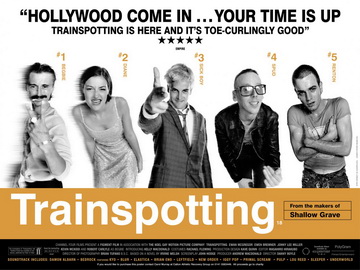
Trainspotting film poster

The poster for the first Trainspotting film shows the five main characters off in their own unique poses. This is to immediately create a sense of identification amongst them however their actions are all facing towards a member of the audience, breaking the fourth wall and enabling us to understand that through their differences, there must be something that links them under one collective.

PICTURE OF POSTER

There is a large headlining review at the top that is an attack on Hollywood films, Boyle's social realist piece is a statement on heroin addicts in Scotland. This gritty piece is unlike Hollywood films and by having a tagline saying 'your time is up!' aims to identify this film as a spectacle that challenges the high grossing films of Hollywood.

Insert another poster picture

The colour scheme is orange white and black, similar to colour schemes of prison uniforms, indicating some form of trap for the characters and some level of a sinister level of illegal acts, as a result from the heroin that the characters take in the film and Begbie is tied to the life of crime by his violent acts, possibly listed as number 1 due to his notoriety?

DECONSTRUCTION OF A WEBSITE- T2: TRAINSPOTTING

The second Trainspotting film shows how the cast from the last film have been getting on with their lives and catches us up 20 years later in real time with the characters.
The website shows Sick Boy and Renton returning towards him. The vast empty space in the shot helps to give the film a minimalistic atmosphere and bring the focus to three main areas: Sick Boy, Renton and the birds in flight. The birds may symbolise the aging process and getting away as Renton does in the first film.

This website is successful as it helps to show the difference in the two films, the first was based around Renton and his friends drugs habit however this second film is more about the progression of the characters after two decades. The scene has been set for the film to still be in Scotland and the relevant links to social media sites have been posted at the top of the web page. The logo is towards the bottom of the screen and dominates the middle where it has the same typography and colour scheme as the typography from the first film. This is to show the plot is continuing on from the first film and make the instant connection between the two films and furthermore the two advertisements as this typography was featured on the poster for the first film.

Casting Character

Casting Character:
Propp's theory of character types allowed us to explore the effects of having an actor/actress and also the absence of an actor. We considered the conventions of a social realism piece and the need for the main character undergoing a change throughout the piece (often this is upon reaching a new equilibrium as Todorov suggests, that the characters are unable to return from).
Having a male actor in this piece was originally scripted and at the start of the piece we had planned several shots where the antagonist of the piece was seen over the shoulder (pinning the actress down). Upon reflection however, we decided that the tone of the piece was to show how our protagonist recovers from the act and not focus on the act itself. Having an actor would've created a drastically different piece that may have been too distressing for some people to watch and created difficulty to film. By having the attackers actions seen but not his face, we enabled the audience to allow their abnormal psyche to scare them into what or who was the attacker, as many horror films tend to do.

GRACE A2 Media Coursework
Our actress needed to be able to portray a high level of emotions seen through various close up and extreme close up shots. Our actress is an a-level drama student who has acted in several filmed pieces before and we chose her to act in this piece to make it clear to people that anyone can be a victim of assault and it is a very real and close-to-home act. By having an actress that audience members could readily identify with, we made our piece real and gritty, as is a convention of the social realism genre.
GRACE A2 Media Coursework

The girl with the dragon tattoo film poster

The Girl with the Dragon Tattoo is a film that starts with the sexual assault of the main female protagonist of the piece. This has a similar opening sequence to our teaser trailer and planned full length feature film. This therefore helped to influence our poster. The poster seen below depicts the two main protagonists of the piece, however one is turned away and one stares dead at the audience. From this shot the power is given to the male protagonist as the female is seen behind him and is not the focus of the piece.

The shadow art seen on the poster of the two protagonists helped to influence how we create our poster. We decided to also use this theme of shadow however we covered half of our protagonists face with the silhouette of the attacker. The Girl with the Dragon Tattoo has a dark grey and black colour scheme which enables it to set the tone of a action film with a serious tone to the piece by not making it a typical explosions and fighting action film. There is a serious issue being addressed in this film by the opening shot and despite not getting that part of the narrative from the posters graphics, the typography indicates that there is something to uncover.
The tagline is useful to spark interest in the full length film. "What is hidden in snow, comes forth in the thaw" indicates that part or maybe all of the narrative of this film is uncovering a secret and possibly overcoming it in the climax of the piece. This is similar to ours and we used a similar style of tagline in our own poster. Taking the idea of two separate statements to create an aura of mystery or uncovering a secret was useful in our piece as we aim to combat the social norms when considering the way society reacts to sexual assault.

The revenant film poster

This poster takes on the use of shadow art to the extent that at the top, DiCaprio's character blends into the forest. This connects him to the narrative of the piece and gives insight to the audience about one of the main locations of the film. The colour palette is predominantly blue and grey, similar to the symbolism shots in our teaser trailer. This helps to create the cold, harsh environment of the film, thus already beginning to generate narrative through a still image.

There is a red flare at the base of the poster and this may be used to symbolise a struggle or fight within the piece, there is a similar poster to the film with the antagonist, Tom Hardy on that has been created in the same way.The similarity between the two characters representations suggests that there is a power struggle within the film and immediately lets us know that these are the two main characters. Thus, through the use of colour and character positioning, the producers have let the audience understand some of the narrative whilst still generating enough curiosity about the full narrative arc in order to draw people in to watch the rest of this film.

The close up shots of both characters allows us to draw conclusions about their roles within the piece. DiCaprio's character doesn't look as confident/menacing and we can therefore see him to be the protagonist. Hardy's character looks stronger, offering a more extreme close up shot with half of his face not seen/shadowed to create mystery and an evil look to him.

Wednesday, 3 May 2017

Typography

When deciding on the title that we would use and how we would present it, we looked to our AS piece and also similar pieces related to the social realism genre.
To get various opinions we created a survey monkey page wherein we combined our ideas to get others opinions on what they thought would make a good title for our piece, link found below:


As the survey was being created and while we waited for feedback to be collected, we decided upon the title 'Grace' for our piece, as the name has doubles up as a word meaning, "to have good will, to add dignity to". Our protagonist suffers from sexual assault in the opening scenes of the trailer seen through straight cut edits between the close up shots of the attack and the disorientated POV shots that follow the attack. This made a connection between the climax of the piece wherein 'Grace' comes to the realization that the attack was no fault of hers and instead, she 'rises above' the attack with 'Grace' in order to try and rebuild her life.

Our survey brought back expected results. The majority of people who were shown our storyboard and narrative arc and then issued with the survey agreed that a one word title is often more effective, such as 'Trainspotting' as there is more focus on one word, however it was also clear that a named character was a popular title idea, creating a connection with the audience and the piece by making it real.