This blog is to document our development over year 13 as we progress in our skills & style. To exhibit our creative platform & manifest our ability to form an original piece we are proud to have constructed.
Here we will deconstruct aspects of the trailer which we are intending to take inspiration from.
The first two shots use childhood footage, established with the "It's a Girl" sign, obviously connotes the gender tension within cases of sexual assault. Using the footage within a white frame of her as a child highlights her purity and vulnerability by originally establishing her as a child.
This nostalgic element is then interrupted by a black screen, where a non diegetic social media bing is synchronous to a "#liar" in blue (the Facebook logo colour).
Again we have the childhood footage of her as an older child within toddler age, with pigtails and a pink dress to aid to the femininity of her. Since it is real footage it is necessary for a documentary, but creates a sense of a relationship with the people as we watch them develop.
We then return to the black screen where again the non diegetic bing reveals a new # which is "#skank" these lexis being connoted to the victims of rape or sexual assault whom people assume are being dishonest about the event.
At this point we are still unaware that we are about to learn the story of two girls, the only hint at this being the reveal of a brunette girl which doesn't correlate to the blonde child we had seen prior. Yet, as we only see one girl at a time it is still ambiguous.
Again we return to the # motif, as the insults progressively grow. We identify one name "#ihatedaisy", and have the use of "#herdrunkstory" again ambiguous to only thinking it is one girl.
We then see the same brunette girl in a bathing suit, in a pool in a high angle family footage shot, acting in a juvenile manner by spitting out the water.
These hashtags grow until they fill up the screen, with the use of "daisy" or "uknew" allows the viewer to understand these were real hashtags and not fictitious to add affect. This highlights an introduction to the grim reality of technology.
These three establishing camera movement shots, ranging from pans, to aerial pieces, demonstrates the small city, to identify the location as a rural town within an American state, however as it is empty it highlights some tension as if there is a valid reason for the people not going outside. It creates the idea of the town having secrets.
The black screen with "two different girls" in a rustic style, then fades to a Facebook profile of "Audrie Pott", then fades to a photo of her with her father, then fades to a Facebook profile of "Daisy Coleman" then fades to a photo of her in the same style. There is still the sense of it being a camera viewing a computer as if you are the person viewing it on your own laptop screen. It introduces us to the two girls, and answers the question that we were confused about with the home footage.
It then fades back to the black screen where in the same style and font it displays "two different communities", one identifies a youthful town with the high school football team and its subsequent cheerleaders. The second is a more rural village identified by the long shot of the sign, and the mid shot of the group of men in caps (further highlighting gender tension). Up until now genders have only been revealed in groups with no integration of the two.
The use of "night" then reveals low key establishing shots of the domesticated settings likely where the attacks took place, this then reveals a blonde girl in an interview close up shot that the audience are already aware are one of the victims of the attack.
Low key lighting of the cars again creates ambiguity to the attacks as the use of the POV close up of the wing mirror makes us feel as the audience as if we are staring into them. This suggests the assaults both occurred at night, since these dark wasted space shots contrast to the past establishing shots in daylight.
Throughout aiding to the realism, documentary aspect we have images of the crime scene where we see bottles of alcohol, demonstrating the importance of this as evidence likely instigating the girls were probably drunk or intoxicated.
More POV shots of the facebook messenger, acting as Audrie Pott, since it is 'Chat with Bob Z' those who know about Facebook messenger and how it works can determine that this has been altered to keep identity hidden of the assailant, further aiding to the ambiguity.
Here the contrast from the long eye level shot of the corridor in the school, full of children, to the low angle shot of the sign depicting "Nodaway County Jail" recognises the ages of the people who are being presented as doing the crime, yet further emphasises the age of the victims also.
We are then shocked as viewers at the use of animation, this is in the same style as a police interrogation, this highlights the same ambiguity as to the identity of the individual and why it is hidden behind an animated figure instead.
Again we return to close ups of the Facebook chats, understanding social media's presence in both cases yet the audience are see 'Joe X' the use of the other identity further emphasises that there was perhaps more than one assailant who will know about what happened.
As previously mentioned, we see crime photos, yet this is alarming for the audience since it is a high angle shot of a females underwear scrumpled up in the corner. As it is still at the crime scene, we realise that the victim did not go home with them on, meaning they were removed from her. As they are pink with smiley faces on, very youthful and feminine to understand more about the victims.
The assailants are presented within the police footage of the interrogation, and the yearbook photo, as the audience never see them filmed by the documentary team, aiding to the ambiguity further, but it also prevents the audience from creating any relationship to them as we do with the interviewees, thus we disassociate ourselves with them.
The low angle tracking shot of her running on the track field, then cutting to an eye level mid shot of her running still, aids to the idea of her being a strong individual despite being the victim (a characterisation aspect for our social realism).
Birds eye pans likely within a drone of the villages where the attacks took place with the post production of tweets such as '#ihatedaisy' '#matt1daisy0' this establishes again the use of twitter and other means of social media within the attack.
The shots of the news stories demonstrates the scale of the national issue that these sexual assaults and rapes became. With the first shot being the use of a twitter hashtag, which is oddly insensitive as it seems cold within the context of sexual assault,
The social realism aspect is highlighted even further with the reference to Anonymous, including the aspects of politics, but this is to highlight the injustice of the female victims for the need for Anonymous to get involved. Using their video publication so the audience feel as if they are part of the news stories, at the time.
We are taking inspiration from these three shots that establish her bedroom to highlight the 'normality' and typical nature of the victims, to demonstrate them as relatable as people, necessary in the social realism genre. Since this is a documentary, looking into their private space of their bedroom is oddly invasive, and we are questionable as to the inhabitants absence.
Yet, this question is answered with this facebook message within an extreme close up, "My life is over." In this finality, the audience become aware that one of the victims committed suicide, a devastating subsequent action of rape with some individuals which we will include within our plot.
Here is our first draft of our storyboard as a rough sketch and plan for our teaser trailer, the following is a deconstruction of our 30 shots that we have in mind to build a definite shooting schedule from.
Shot 1: A close up eye level shot of a still candle, within low key lighting. (Inspiration see "Mood boards" post)
Shot 2: Low angle extreme close up of hand gripping forest dirt floor.
Shot 3: A close up eye level shot of a flickering candle, within low key lighting.
Shot 4: Eye level close up of male feet positioned in upper third, with female feet below, to subliminally demonstrate the position of the assailant overpowering the victim.
Shot 5: Close up high angle almost POV of the assailant with his hands covering the protagonists face (this will demonstrate her fear, to highlight how this is not a permissive sexual encounter.)
Shot 6: A close up eye level shot of a flickering candle, within low key lighting.
Shot 7: Low angle perhaps in the dirt, of the male arm overpowering the female arms again by having it pushing the limbs to the floor, not only to recognise the strength but the total lack of freedom to victim has in such a sexual assault.
Shot 8: A close up eye level shot of a blown out candle, within low key lighting.
Between these we will have the subliminal shots fading into black screens, the symbols contrasting to the sexual assault as calm vs terror. The black screens aid to build up the tension, yet since it is not a montage edit we are building from our editing type from last years coursework, whilst creating a more serious and mature tone to our social realism piece.
Shot 9: BLACK SCREEN.
Shot 10: High angle almost birds eye close up within the ambulance post attack of her laying on the ambulance bed.
Shot 11: Stop motion close up eye level of an egg cracking. (Reference to "Pitch" blog post, with specific acknowledgment of the symbols slide.)
Shot 12: Match on action of same shot but within the woods laying on the forest floor.
Shot 13: Eye level extreme close up of melting candle to continue the integrated theme (Note blog post "Pitch" again acknowledging symbols slide.)
Shot 14: Long angle pan across the bedroom establishing her as a atypical 'normal' girl whom the audience can identify with, further emphasises the realism aspect using domesticated setting.
Shot 15: High angle almost birds eye of her laying on her bed in a curled up foetal position (emphasising vulnerability), on the bed we had previously established.
Shot 16: Stop motion close up eye level of an egg cracking.
Shot 17: Match on action of same shot of her in same position but on the forest floor again.
Shot 18: Eye level extreme close up of melting candle.
Shot 19: Close up eye level pan of her in a car or train travelling with her head on the window, leaning whilst crying.
Shot 20: Match on action of her within the same position in same pan yet with her head on a tree trunk (perhaps with some blood on her face to recognise its post attack).
Shot 21: Extreme close up of her brushing her teeth.
Shot 22: Match on action of same shot yet getting swabs post attack.
Shot 23: Stop motion close up eye level of an egg cracking.
Shot 24: Long angle of her in the middle of a crowd, surrounded by people likely in a corridor or even in shopping centre.
Shot 25: Match on action of same shot but her in the woodland, perhaps even with the perpetrator positioned behind.
Shot 26: Eye level extreme close up of melting candle.
Shot 27: Stop motion close up eye level of an egg cracking.
Shot 28: Extreme close up high angle (almost POV) of blade about to slit a female wrist.
Shot 29: Match on action of above shot, yet using a fruit such as a blood orange etc to imitate the blood spillage, more as a metaphorical symbolism, yet also to be subliminal.
Shot 30: Extreme close up eye high angle of a cracked egg, with the yolk spilt across a white surface or even red rug.
Characters
Ahead of our decision on what characters and actors we wanted for our teaser trailer, we decided to do some research into a variety of different characters from films of the social realism genre.
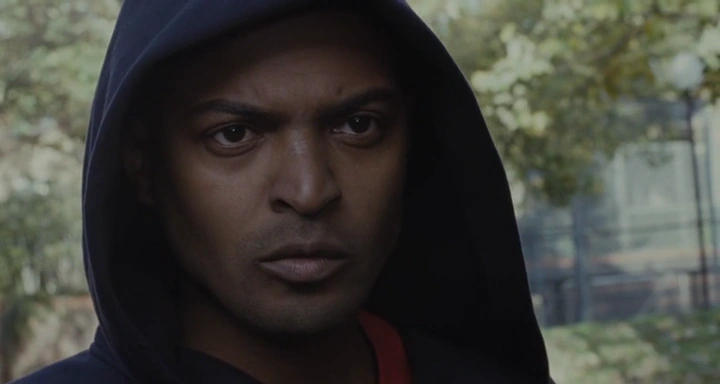
Sam Peel (Kidulthood, Adulthood, Brotherhood)
Sam Peel is portrayed as the antagonist in the first film. He appears in a very negative light, as the school bully. The film follows a story in which some boys trick their way into his house to retrieve a Game Boy he had stolen from them, they also steal his cannabis and one has sex with his girlfriend. When Sam returns he aggressively threatens them and consequently is attacked, and so is his mother. Here, it is clear that the plot conforms to stereotypes of everyday life for teenagers/young adults in West London. His character is shown to be very aggressive and dominant throughout, after witnessing his mother being knocked to the ground he attacks and beats 'Trevor' with a baseball bat, resulting in death.
The second film (Adulthood) shows Sam's struggling but evolving character where it begins with his release from prison. His character is proven to have changed dramatically, making it clear he is not the person he was six years ago by learning from his mistakes. In the film, Sam is attacked on a bus after the murder is brought up in conversation, although he does gain control of the fight beating the man into submission. These actions show that the character is still troubled thus conforming to the stereotypical West London young adult from a low-income background. Adulthood also includes Sam having flashbacks to his prison days proving just how much the crime haunts him. At one point in the film, Sam finds himself in yet another life-threatening situation which evolves into him being in a position of revenge, as he is about to kill 'Dabs' he has another flashback to the murder and relents; portraying his guilt and changed behaviour. In another scene, Sam mugs a couple walking down a street at gunpoint, although this shows he's still troublesome and criminal, he apologises for doing it, something he wouldn't have done in the previous film.
Susie Salmon (The Lovely Bones)
Susie Salmon is a 14 year old girl from Norristown, Pennsylvania. After taking a shortcut home from school, she was persuaded into her neighbour's house to take a look at an underground den he recently dug. He then raped and murdered her, leaving her remains in a safe and then dumping them in a sinkhole. As her spirit travels to her personal heaven, it passes one of her classmates, a social outcast named Ruth.